
Astaxanthin + Lycopene: The Math Behind the Carotenoid Duo
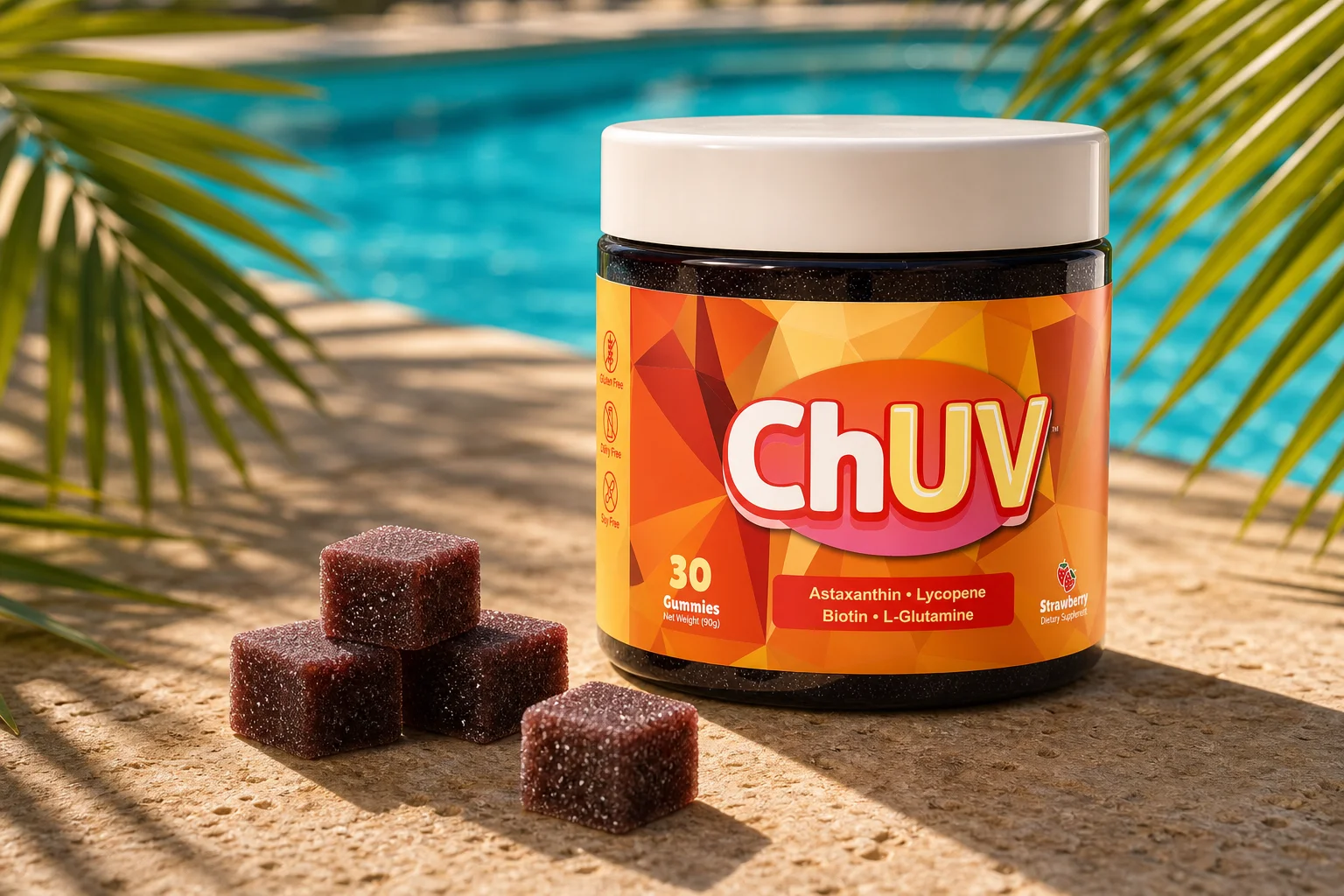
Astaxanthin + lycopene is not just a formula pairing, it is a biochemically strategic combination. These two carotenoids target different layers of photoprotection and skin-tone support, which is why ChUV Tanning Gummies brings them together in a single daily gummy. Understanding why this duo performs the way it does helps explain the visible results.
By CAYO Nutra Team, Supplement Specialists
What Astaxanthin and Lycopene Each Bring to the Table
Carotenoids are fat-soluble pigments your body cannot synthesize on its own, making dietary intake or supplementation the only way to build tissue levels. Both astaxanthin and lycopene belong to this family, but their chemical structures, cellular locations, and mechanisms of action differ in ways that produce meaningfully different biological effects.
Astaxanthin is derived from Haematococcus pluvialis microalgae and classified as a xanthophyll carotenoid. Its molecular structure is wide enough to span the full thickness of a cell membrane, allowing it to neutralize reactive oxygen species on both the interior and exterior sides of the lipid bilayer at the same time. A 2014 review by Fassett and Coombes published in Marine Drugs noted that astaxanthin's antioxidant capacity against singlet oxygen is roughly 550-fold greater than vitamin E and approximately 11-fold greater than beta-carotene, placing it among the most potent antioxidant compounds studied in the carotenoid class.
Lycopene is an acyclic carotene and the pigment responsible for the red color in tomatoes and watermelon. Its highly linear molecular structure creates a delocalized electron system that is exceptionally effective at quenching singlet oxygen. Research by Rao and Rao published in the Canadian Medical Association Journal in 2007 identified lycopene as one of the most efficient singlet oxygen quenchers present in human plasma. Unlike astaxanthin, lycopene distributes across both the dermis and epidermis, covering a different physical zone of skin tissue.
How the Astaxanthin + Lycopene Combination Creates Synergy
The astaxanthin + lycopene pairing does not simply add two antioxidant scores together. The two molecules operate across complementary biochemical pathways, producing a protective effect larger than either achieves individually.
Astaxanthin accumulates primarily in the skin's dermis and works intracellularly, shielding DNA and mitochondrial membranes from UVA-induced damage. Lycopene's linear chain structure makes it especially effective against singlet oxygen generated by UVB exposure at the skin's surface layer. Together, they address the full UV spectrum through what researchers call spectral complementarity.
A 2019 paper by Stahl and Sies in Molecular Aspects of Medicine found that carotenoid mixtures show synergistic photoprotective effects compared to single carotenoids administered at equivalent total doses. Part of this synergy involves carotenoid recycling: when one antioxidant molecule is oxidized and temporarily inactivated, adjacent carotenoid molecules can donate electrons to regenerate it, extending the protective window.
Oxidative Stress, Melanogenesis, and the Color You Actually Want
Oxidative stress, the condition where reactive oxygen species outpace the body's antioxidant defenses, is one of the primary consequences of UV exposure. When skin cells absorb UV photons, they generate singlet oxygen, superoxide radicals, and hydrogen peroxide. These molecules can damage lipids, proteins, and DNA at the cellular level.
Beyond direct cellular damage, oxidative stress also disrupts melanogenesis, the biological process that produces melanin. Under high oxidative conditions, melanin synthesis becomes irregular, producing uneven pigmentation rather than the consistent warm tone most people are after.
This is where the lycopene astaxanthin pairing becomes directly relevant to visible skin outcomes. By reducing oxidative stress at both the epidermal and dermal levels, these carotenoids support a biochemical environment where melanin can be produced more consistently. The result is a uniform, natural-looking color build rather than the patchy or reactive response that often comes from high UV exposure without adequate antioxidant coverage.
For more on how the choice of carotenoid affects what kind of color change occurs in skin, our deep dive on Why ChUV Skips Beta Carotene explains the contrast between compounds that cause unnatural yellowish-orange tinting and those that support a natural warm glow.

What the Clinical Research Shows About Skin Accumulation
Both astaxanthin and lycopene are fat-soluble, meaning they require dietary fat for absorption and transport through the lymphatic system before reaching skin tissue. Their tissue levels are measurable, dose-dependent, and have been confirmed in controlled human studies.
Research by Stahl et al. published in the Journal of Nutrition in 2001 confirmed that participants who consumed lycopene-rich paste for 10 weeks showed significant increases in skin lycopene concentration, with those increases correlating with reduced markers of UV-induced oxidative DNA damage.
For astaxanthin, a 2017 human clinical trial by Tominaga et al. published in Acta Biochimica Polonica measured improvements in skin moisture, elasticity, and surface texture after 16 weeks of supplementation at 6mg daily. The authors attributed the changes to antioxidant accumulation in skin tissue rather than surface-level effects.
These findings explain why tanning supplement protocols typically require 4 to 8 weeks of consistent daily use before the full range of skin effects is visible. Tissue accumulation takes time, and the color changes that result from carotenoid supplementation correspond to a gradual biological process, not an immediate surface reaction.
Why the Astaxanthin + Lycopene Ratio Matters
Not all astaxanthin + lycopene formulas are equivalent. The ratio between the two carotenoids influences which segment of the UV protection spectrum receives more coverage. A formula weighted too heavily toward one compound leaves gaps that the other would otherwise fill.
Delivery format also affects performance. Fat-soluble carotenoids dissolved in a lipid-compatible matrix show significantly better bioavailability than the same compounds in a dry-powder or water-based delivery system. This is because micelle formation during digestion, the mechanism that carries fat-soluble compounds across the gut wall, depends on the presence of lipids in the delivery environment.
A chewable gummy matrix is designed with this absorption principle in mind, providing a fat-compatible medium at the point of consumption rather than relying entirely on the fat composition of the surrounding meal.
Frequently Asked Questions
How long does it take for astaxanthin + lycopene supplementation to produce visible results?
Clinical data on carotenoid skin accumulation shows measurable tissue concentration changes beginning around 4 weeks of consistent daily use, with peak levels typically reached between 8 and 12 weeks. Visible color effects generally align with this timeline, though individual results vary based on baseline skin tone, UV exposure habits, and the fat content of your diet during supplementation.
Can food alone provide enough lycopene and astaxanthin for skin benefits?
Dietary lycopene from cooked tomatoes, watermelon, and red peppers can reach meaningful tissue levels. Astaxanthin is more difficult to obtain from food alone. The richest natural source is wild-caught sockeye salmon at roughly 1.5mg to 3.8mg per 100g serving. Doses used in clinical photoprotection studies are generally not achievable consistently through diet, making supplementation the practical route for most people.
Does the lycopene astaxanthin combination replace sunscreen?
No. Carotenoid supplementation provides internal photoprotection by reducing the cellular consequences of UV exposure, but it does not block UV radiation at the skin's surface the way a topical SPF product does. Internal carotenoid coverage and topical sun protection work through different mechanisms and are best used together as complementary strategies, not substitutes for each other.
Why does oxidative stress matter for tanning results?
Oxidative stress interferes with melanogenesis, the process that produces melanin. When reactive oxygen species levels are high, melanin synthesis becomes irregular, producing patchy or uneven pigmentation. Reducing oxidative stress through consistent antioxidant supplementation supports more controlled melanin production, which corresponds to a more even, predictable tan rather than a reactive or inconsistent skin response.
Is the color effect from lycopene and astaxanthin considered natural?
Yes. Unlike beta-carotene, which can cause unnatural yellowish-orange discoloration when consumed in excess, lycopene and astaxanthin at standard supplementation doses support melanin-based color change rather than direct carotenoid staining in the skin. The resulting color reflects sun-activated melanin, consistent with a natural warm glow.
Build Your Tan on a Solid Biochemical Foundation
The case for astaxanthin + lycopene is built on how these two compounds protect and support skin at the cellular level through distinct and complementary mechanisms. If you have questions about the formula or want to learn more before starting your supplementation routine, the team is reachable through Contact.


